The Lazarus Code
Let's say the person you loved died and came back—all of them, down to the small cruelties and the way they laughed—would it matter how?


1 | Nine Months of Arithmetic
You have been counting.
Two hundred and seventy-six days since the Coast Guard called. Nine months and three days since the research vessel Meridian went down forty miles off the coast of San Diego and took Shelly with it. You did the arithmetic on the morning they declared her dead, standing in the kitchen of the house you both chose—the one in Mission Hills with the red door she insisted on—and you have done it every morning since. You cannot stop. Counting is the only kind of faith you have left. The faith that the numbers mean something, that if you track precisely enough, the loss will eventually make sense.
It hasn’t.
The room is the way grief rooms become when nobody takes care of them with any real intention. Two piles of papers on the desk that started as separate projects and have merged into one indistinguishable mass. A cup of tea made four hours ago and untouched. The theology books on the shelf are Shelly’s, most of them. She bought them one by one over a year and a half after you told her, slowly and with some embarrassment, that you were losing your faith. Not all at once. By degrees. The way a house loses heat in winter. You’d told her on a Sunday evening, coming back from the church on Adams Avenue she’d chosen because she liked the pastor’s willingness to sit with hard questions, and she hadn’t lectured you or panicked. She went to the bookstore on Saturday morning and came back with Brueggemann and Moltmann and a worn Nouwen she’d found in the secondhand section, and she set them on the shelf without comment. That was how she loved you. She made space for what you couldn’t hold yet.
You haven’t opened any of them in the past three months.
The screen on your desk has two things open. One is your Bible software, stuck on Psalm 22 since seven in the evening. My God, my God, why hast thou forsaken me. You haven’t read past the first verse because the first verse is the only one you can stand to look at right now. The other tab is a thread on X you found last week. A young academic from Lagos making the argument, carefully and at length, that Christianity was introduced to the African continent as an instrument of colonial disorientation, and that the appropriate response was to return to the traditions of your fathers.
You have read it three times. You have not liked it. You have not closed it either.
Your grandmother used to set a place at the table for your grandfather on the anniversary of his death. Not symbolic. An actual plate, served hot, the same food she cooked for everyone else. She would point to a gesture in one of the grandchildren—a way of tilting a head, a particular pause before speaking—and say,“ There he is, you see.” You asked her once if she was waiting for him to come back, and she said he never left. You were fourteen and thought she was a woman who missed her husband too much to think clearly. She was also a church warden at St. Bartholomew’s for thirty years, poured libations for the dead on their anniversaries, and saw no contradiction between these two things. You asked her about that too, the same year, freshly confirmed and full of the certainty confirmation provides for about eight months. She looked at you and said, “My child, the spirit is not a tenant. It doesn’t take one house and stay.” You didn’t know what to do with that at fourteen. You have been carrying it for more than twenty years, and you are not sure you know what to do with it now, either.
You were nineteen when you left Onitsha for Boston. Government scholarship, full ride, Robotics Engineering at MIT. Your mother stood in the yard in the morning dark before the car came, held your face in both her hands, and said nothing, which meant more than anything she could have said. You carried the memory of her hands on your face across the ocean, and through two years of winter you had no reference point for, two years of being the only Nigerian in most rooms you entered, two years of learning what it costs to be legible in a country that has no context for where you came from.
And then Shelly.
Second year, fall semester. She was in the materials lab on a Thursday afternoon when you came in looking for a spectrometer, and she was already using the one you needed. The conversation that started over shared equipment went for three hours and ended with her asking if you wanted to get coffee, and you saying yes before you’d finished processing the question. She was studying Marine Biology. She had a laugh that arrived without warning. When she read, she went completely still, eyebrows slightly raised, fully present and somehow also somewhere else. By the end of your second year, you knew she was the person you wanted to build your life around. By the end of your third year, she agreed. You married in June, three weeks after graduation, in a ceremony that was too small for her family’s expectations and too large for yours. Your mother flew over. She held Shelly’s face in both her hands the way she had held yours in the yard that morning, and you stood there watching it happen and felt something break open in you that you still do not have a name for.
Eighteen years in the United States since then. A postdoc in Boston, a research position in Austin, and the robotics faculty post at UCSD that brought you both to San Diego seven years ago. Shelly following her own career at Scripps, the house with the red door, the life built piece by piece from the specific combination of who you both were. You became something here that you could not have become in Onitsha. You are not certain whether to call that gain or loss or something without a name yet. What you know is that Shelly was the architecture of it. Not metaphorically. She was the actual structure. Without her, you are standing in a building with no walls.
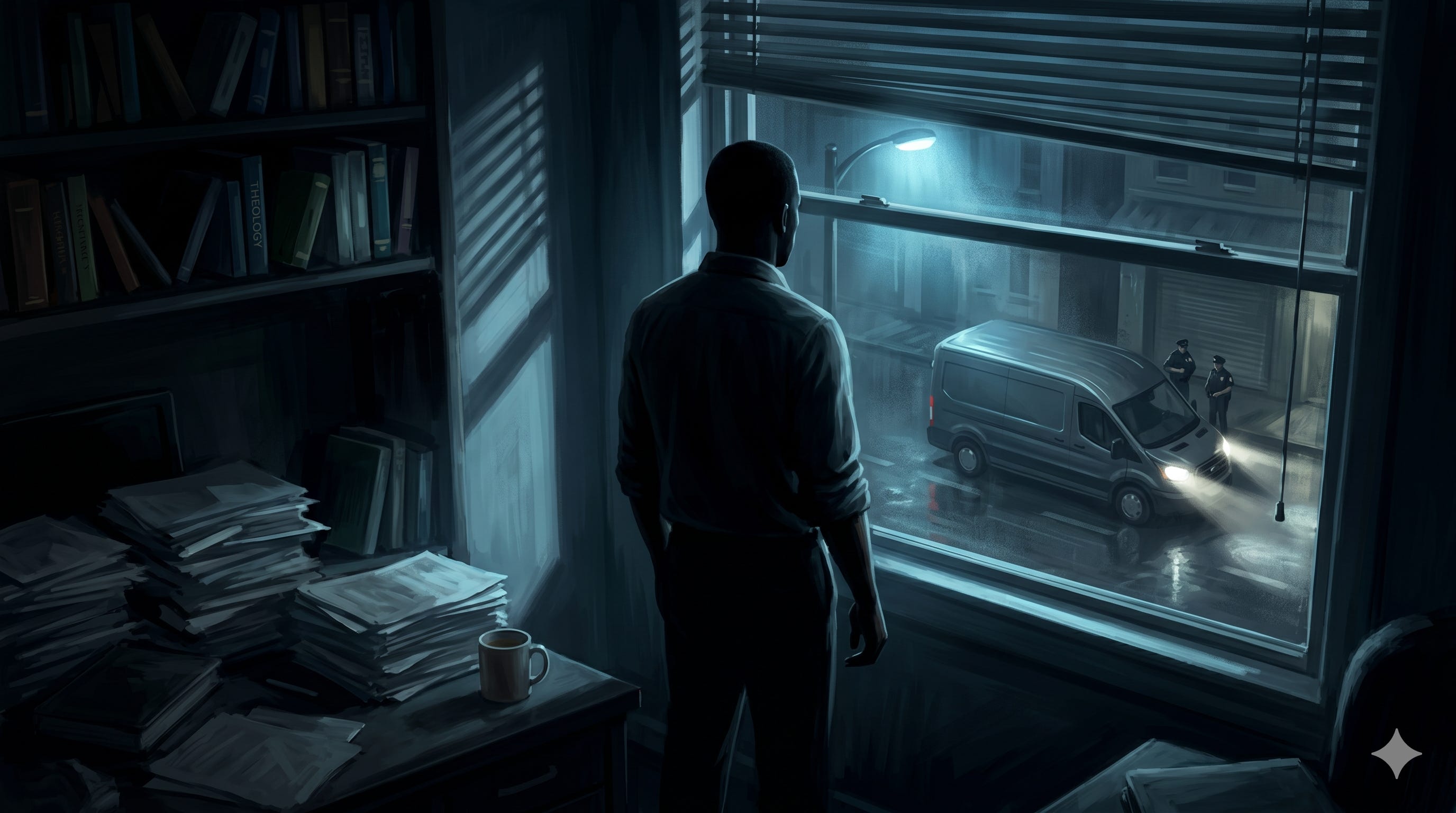
The van comes at 11:47 PM. There are no markings on it. No plates you can read from the third floor. Three days ago, a letter arrived on government stationery with your full name on it. Anayo Chukwuemeka, not the shortened version you use at the university. A reference number, a time, an address in Coronado, no other explanation. Whoever wrote it knew what you were actually called. That detail bothered you more than anything else in the letter.
You stand at the window and watch the van idle for one minute and twenty seconds. You think about not going down. You think about calling someone. Your colleague Marcus, maybe. Dr. Harrington, who runs the department and has been covering your classes with a gentleness that embarrasses you. You think about the fact that grief does something specific to the part of the brain responsible for caution. It tells you that caution is a luxury of people who have something left to lose.
You go down.
You get in.
You do not know why. Or you know why and cannot say it yet. Because the only thing worse than the call that comes next is the possibility that no call ever comes.
2 | What the Soldiers Promised
The complex is over the bridge and south on a road that stops being marked after the third turnoff. You go through a gate, past floodlights, past men in uniform who check your name against a list and wave you through without expression. A woman in civilian clothes takes your phone without asking and sets it in a labelled box. The corridors go on longer than the building should be able to contain.
The man escorting you is not unkind. He simply has no interest in your questions. He walks at a pace that keeps you half a step behind him, always looking at the back of his uniform, always one turn from losing him at the next junction. It takes you ten minutes to understand that this is intentional. You move through this building the way water moves through pipes. No choice about direction.
Dr. Elias is waiting in a room that is cold enough that his white coat is functional, not theatrical. He is a man in his mid-sixties with careful eyes and the specific stillness of someone who has spent thirty years convincing funding committees of difficult things. He does not perform enthusiasm. He shakes your hand once, says your name once. Then he tells you why you are here in the same tone a surgeon uses to explain an operation. Technically, without apology. His certainty about the science is not the thing you should be afraid of.
He tells you about the Lazarus Code.
He shows you the vessels first. Twelve of them, standing in rows along the far wall, each one sealed, each one shaped close enough to a human that you have to look twice to confirm they are not. He shows you the protein sequencing data on the screens, the cloning architecture, and the neurological mapping process. He explains it without flourish. His voice does not change. That is the most frightening thing about him. Not what he is proposing. That he has made his peace with it so completely that he no longer needs language to soften it.
Then he opens a folder and sets it on the table in front of you.
Shelly’s signature is on the first page. You know her handwriting the way you know the sound of her key in the door. The particular way she looped her lowercase l. The way the capital S of her name always leaned slightly forward, as if it were in a hurry. The forms are dated fourteen months before the accident. She was recruited through her work with the Naval-attached marine research programme. Her security clearance made the approach possible, Dr. Elias explains. Her expertise in deep-sea biochemistry made her valuable in ways that extended well beyond the obvious. She was brilliant, and she was cleared, and she believed in hard things.
“She agreed to participate,” you say.
“She did.”
“She agreed to have her—” You stop because you don’t have the word yet. “To have this done.”
“She agreed to donate her genetic profile and complete neurological mapping to the programme.” He is precise about this. “She was not told that the cloning protocol had never been completed on a living subject before. That information was classified at the time of her recruitment.” A pause. Calibrated. “The data we needed to complete the process—the precise neurological recording at the moment of biological shutdown—we hadn’t been able to capture under controlled conditions. Her death provided it.”
You sit with that sentence.
Her death provided it.
It was a storm. The weather report was real. The Coast Guard investigation was real. The search lasted eleven days and found nothing. You have no evidence otherwise. You have nothing but the cold arithmetic of what Dr. Elias has just told you: that the breakthrough they had been waiting years for arrived on the same night that Shelly drowned, and that the machines monitoring her were running, and that the data came through clean.
“There is one more thing,” he says. “She left instructions designating you as next of kin for the programme’s activation clause. The final step of the process—the pulse that initiates consciousness reintegration—requires the authorisation of the designated party.” He holds your gaze. “She chose you. She wanted you to make the decision.”
You look at the folder. At her signature on the page. At the particular lean of that capital S.
Even this, she made into an act of love.
“No,” you say.
You stand. You mean it. Every step toward the door is deliberate. You are a man who has made a decision, and the decision is grounded in everything you have believed and claimed to believe, and you walk out of the cold room with it solid in your chest.
3 | A Man Who Prays in Two Tongues
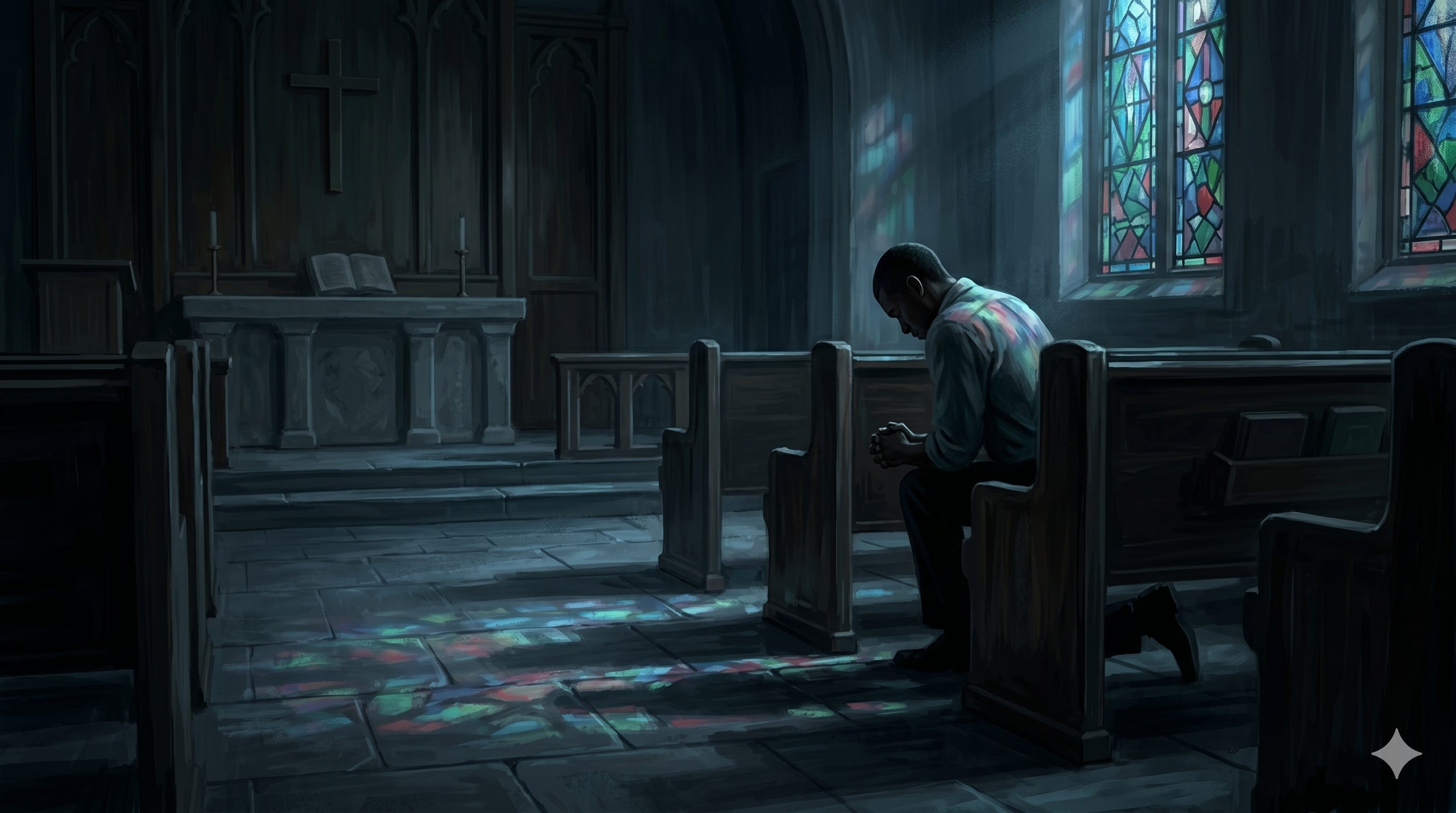
The chapel is on the east side of the complex, between a server room and what sounds like a laundry. Someone built it with real care. Proper wood in the pews, stained glass that catches the corridor light, a cross at the front that is not decoration. It smells like beeswax and aged paper. You sit in the front pew, and you try to pray.
You start in the language you learned first.
Our Father, who art in heaven. You know every word. You have known them since your mother made you stand in the parlour each morning before school at age six, hands folded, facing the wall. You get to thy kingdom come, and you stop, because the next line is thy will be done, and you have been unable to finish that sentence for nine months. You know what it means. It means that the God you have been performing belief in for thirty years looked at your wife and chose the ocean at night in a storm for her. Shelly, who read Brueggemann in bed and burned incense during Lent and cried every single time she heard the Hallelujah Chorus. Shelly, who was more committed to your adopted faith than you had ever been, who had no grandmother with competing traditions to give her permission to doubt. You cannot say thy will be done about that. You have tried.
So you try the other language.
Not words, exactly. More like an orientation. You close your eyes, and you try to face the direction your grandmother faced when she spoke to the dead. To your grandfather, gone before you were born. To her own mother, who had lived to ninety-seven and died in the room she was born in. She addressed them directly, without ceremony, expecting to be heard. She set out their food on the anniversaries of their deaths. She believed the dead remained present if you left room for them. She would point to a stillness in a room and say, simply, that they were here. She also knew Psalm 91 by heart and said it with the same confidence. She left the reconciliation to God, whom she trusted was better at it than she was.
You were ten years old when your closest friend Emeka died of malaria in three days, after you had prayed for him every morning, after you had believed completely that the prayers were doing something. Your grandmother sat you on the veranda with a cup of zobo, and she said, “Your spirit companion is with you. Emeka’s has gone home. These are not the same loss. Do not grieve them the same way.” It didn’t land then. Standing in a military chapel at 1:00 AM, you are not certain if it has landed now.
Here is the question you have not asked yourself until tonight:
What does your tradition say happens to a spirit that gets captured by a machine?
Not the Christian tradition—that one has Lazarus and bodily resurrection and the promise of the last day, and it is a tradition that your wife believed in with a thoroughness that puts you to shame, and it does not, as far as you can find, address the Lazarus Code. Not the other tradition—the one that says the dead return in new forms, that the line between the living and the gone is thin and navigable. That one also does not address this. You are standing in a gap between two worldviews, and neither of them has a map for where you are.
The irony is not lost on you. You left Onitsha at nineteen to study robotics. You spent your career engineering the boundary between human intelligence and machine capacity. You have published papers on neural interface architecture. You are one of the twenty people in the country most qualified to understand exactly what Dr. Elias built. And you cannot use any of that knowledge here, because the question is not technical. The question is whether there is something that a machine cannot map. Whether a person is more than their accumulated data. Whether the part that matters is the part that can be recovered. Or whether it is precisely the part that cannot.
Shelly would have known what to say about this. That is the cruelty of it.
Your knees are on the cold stone floor. You don’t know when you got here.
You are not certain you believe in resurrection. You are not sure you ever did. You sat in the pew on Adams Avenue, and you recited the creed—on the third day he rose again—and it was a historical statement to you. The way the moon landing is a historical statement. Something that happened and shaped what came after, but does not rearrange anything in your chest when you say it.
What rearranged something in your chest was Shelly reading the Lazarus account aloud in the kitchen on a Sunday morning, stopping mid-verse, setting down her spatula, and saying, “That’s the part that gets me. Not the miracle. That he stood in front of the tomb and wept first.” She was completely serious. She had an egg in her hand. She stood there with egg on her hand and the most serious face you had ever seen on her, and she said, “He was about to raise him, and he still cried. That means the dying still mattered. The coming back doesn’t cancel what was lost.”
You have been turning that over for nine months. You have not reached the bottom of it.
You have also not answered the question that is actually keeping you on this floor. It has nothing to do with theology. You can debate resurrection all year. The question that will not let you up off this cold stone is the one you have been refusing since the corridor:
Are you saying no because it is wrong, or because you are afraid?
Afraid that what comes out of that vessel will have her voice and her face and her particular way of reaching for your hand in the dark, and that you will let yourself forget, over time, that it is not her. Afraid that the forgetting will happen so gradually that you won’t notice until it has already happened. Afraid of how much you want it to happen. Afraid that the wanting itself is a betrayal of the woman who actually drowned.
And beneath that: afraid that you will not be able to tell the difference. Not because the technology is so perfect. Because grief is so desperate. Because nine months of counting days and leaving her books on the shelf and sleeping on your side of the bed have become a habit that has nowhere to go. Nine months of that. Maybe you would accept anything that wore her face. Maybe you already know that about yourself.
Your grandmother would have said, “The one it is will be known in the end.” She said it about people, about disputes, about situations that seemed unresolvable. You wait for the announcement.
Nothing comes.
Or maybe the silence is just a chapel at 1 AM. You are alone and have to make a decision without the thing you need most: certainty. You have never had certainty about God. You have had faith and doubt in varying proportions, and you have called the mixture different names at different ages. What you had with Shelly was not certainty either. It was something better. It was the daily choosing to remain. That was the whole of it.
The chapel is cold and quiet, and it has not helped. You have decided anyway, which is perhaps exactly how decisions like this get made. Not in the presence of signs, but in their absence. Not when you know it is right, but when you cannot live inside the alternative.
You walk back down the corridor.
You find Dr. Elias in his office.
You tell him you have changed your mind.
He does not look surprised. You decide not to think about what that means.
4 | What the Machine Named Her
They prepare the vessel for three hours. You wait in a room with a cot, a vending machine, and a window that faces the parking lot. A guard brings you coffee that tastes like it was made sometime last year, and you drink both cups. You read Psalm 22 all the way through for the first time in nine months. For he has not despised or scorned the suffering of the afflicted one; he has not hidden his face from him but has listened to his cry for help. You read it twice. You don’t know what to do with it. You write nothing down.
At 3:17 AM, Dr. Elias comes and takes you to the room.
There are six technicians. They work with the ease of people who have rehearsed something many times. Efficient, without discussion, each movement meeting the next without seam. You understand that rehearsed is not the same as tested. You understand that you are both the test and the witness.
The vessel is sealed. You stand twelve feet from it. Dr. Elias stands to your left.
“It will take a few minutes once the pulse is administered,” he begins. “The neurological patterning requires time to—”
“I understand,” you say.
He gives the signal.
What follows is not dramatic. A low tone, felt in the sternum before it reaches the ears. The vessel’s surface dims, then brightens, then returns to normal. Then nothing for ninety seconds. You count them.
Then: a breath.
One breath. Drawn as though whoever is drawing it has been waiting a long time for the chance.
The vessel opens. The technicians move in. They steady and guide in a way that tells you this moment has also been rehearsed, and that the rehearsal did not involve a body that was hers.
She is facing away from you. She looks at her own hand. She turns her head, slowly, finding the room, the wall, the technicians one by one. Then you.
“Anayo.”
Her voice. The exact register of it. The way it rises at the end of your name, faint as a question mark, as though she is confirming something.
You cross the room. You do not decide to. You are simply on the other side of it, holding her, and the technicians step back, and the machines hum around you in the cold.
5 | The Hair That Didn’t Change
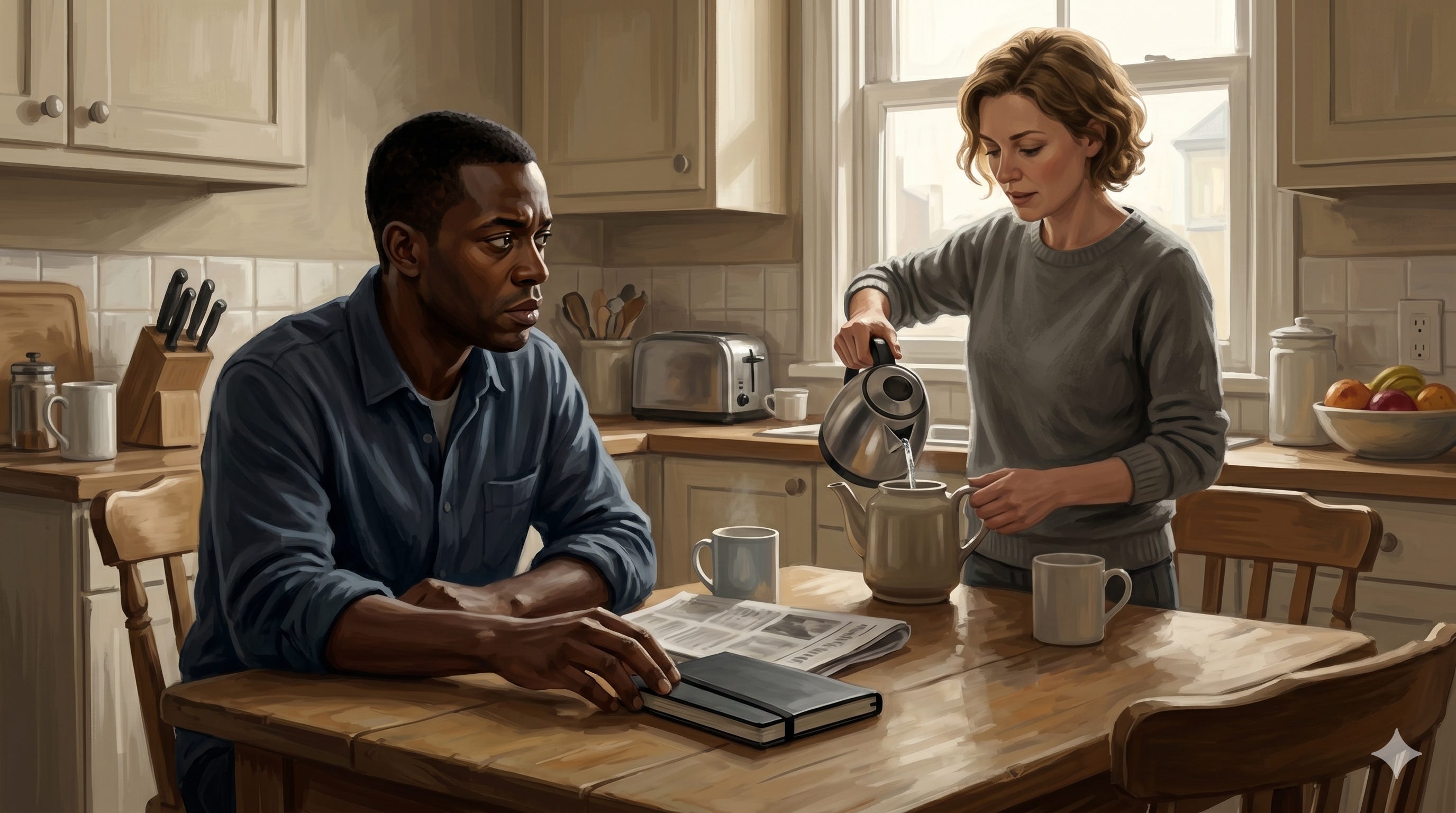
You keep a notebook. Small, black cover with an elastic band across the front. You tell yourself it is an academic habit. The reflex of a man trained to observe. You know that is not entirely why.
The first entry is from a Tuesday morning, three weeks after she comes home:
Hair. Three weeks exactly, and it is the same length as it was on the first day. Not close to the same length. The same. Hair grows. Even slowly, it grows. You can track it week to week if you are paying attention. I have been paying attention. I have not told her this.
The second entry is from that Friday:
She made jollof rice tonight. I don’t know how else to put this: it was correct. Every proportion, every timing. The same jollof rice she used to make. The kind that took her two hours and produced more than two people could eat in three days, the kind she made on Friday evenings when she was happy. She learned it by watching YouTube videos in the first year of our marriage, pausing, rewinding, and taking notes, and she got it right through stubbornness alone. Tonight it was identical. I ate two plates, and then I sat in the bathroom for a long time trying to understand what I was feeling. What I was feeling was that nothing was wrong. That was what was wrong.
The third entry is eleven days later:
She used a word today that she learned in the first years of our marriage, a word I’d taught her from back home, the kind of word that only sounds right when it’s grown into you rather than learned. She used it correctly. The pronunciation was right—the vowels, the consonants, everything a person checks without knowing they’re checking. What was missing was the weight behind it. The particular way a word lands when it belongs to you rather than to your husband’s grandmother. I cannot explain exactly what I mean. I know exactly what I mean.
The fourth entry is a Sunday, three weeks after that:
I made akara this morning. Same recipe, same problems: oil too hot, the first batch burned, the second batch pale and soft in the wrong places. She ate them. Refilled her plate without being asked. When I said they weren’t right, she said, “They’re yours, so they’re right to me.” Those exact words. That exact register. The same small mercy she used to give me in Boston. I sat in the car afterward for twenty minutes. I will not write down why.
You do not show her the notebook. You do not show it to anyone.
She is at breakfast. She laughs at something on the news. She reaches for your hand at night. You take it. You hold it and run a comparison in the back of your mind between the weight you remember and the weight you are holding, and you arrive at a number that means nothing, because you do not know if memory is reliable enough to measure against. Grief invents. You know this. You have read the psychology. The mind fills the outline of the lost person with whatever it needs to put there. You cannot trust your own records.
This is what you write in the fifth entry:
I don’t know if I am looking for proof that it’s her or proof that it isn’t. I don’t know which verdict I’m building toward. I don’t know which one I could survive.
You close the notebook. You put it in the desk drawer under a stack of papers. You go to the kitchen. She is making tea. You sit at the counter and talk about nothing in particular. A news story. Whether the car needs servicing. You are present for it. Completely present. It is the most difficult thing you do all week.
She looks up at one point and catches you watching her.
“What?” she says. There is warmth in it, not defensiveness.
“Nothing,” you say.
She gives you the look she always gives you when you say nothing but mean something. The look that said: I see you, and I’m giving you time, and when you’re ready, the door is open. That look. Exactly that.
You write nothing in the notebook for six days.
6 | A Rehearsal for Love
It started as a Sunday routine in the second year of your marriage and never stopped: you attempted akara from your grandmother’s recipe while she watched, offering the kind of commentary that was half encouragement and half barely-contained laughter. The problem was the ingredients. What she could find in Boston in those years was not what your grandmother worked with in Onitsha, and the result was something that could charitably be called an approximation. You burned the first batch. You over-salted the second. The third came out pale and structurally ambitious, and she ate them without comment, every single one, refilling her plate, and when you said, “They’re not right, are they?” she said, “They’re yours, so they’re right to me.”
You have been attempting the recipe again lately. Getting it wrong in the same ways.
On this particular Sunday evening, she makes chicken stew because it is cold enough to want something warm. You sit across from her and eat. The conversation moves through small things: a colleague who has been passed over for promotion again—the third time in four years —and everyone pretending not to notice; the news; whether the kitchen tap needs a new washer. You are both inside the ordinary of it. You know it, and you think she does too, and that shared awareness is its own kind of intimacy. Living inside a life that you have both agreed to treat as real.
The question arrives in the middle of the second bowl. You had been keeping it behind your teeth for weeks.
“Tell me about the morning before the expedition,” you say.
She looks up. She sets down her spoon.
You wait.
“Which part of it?” she says.
“Any part. Whatever you remember.”
She is quiet for a moment. Not long. Five or six seconds. Then: “You burned the eggs.”
Neither of you speaks.
You burned the eggs that morning. You always burned eggs when you were anxious, because anxiety made you leave them too long and check your phone instead. You were anxious that morning because the weather forecast had been inconsistent for three days, and you didn’t like the pattern. You burned the eggs, and Shelly scraped them into the bin without comment and made toast instead, and neither of you acknowledged it, because acknowledging the eggs would have meant talking about the anxiety and talking about the anxiety would have meant talking about whether she should go, and you had had that conversation twice already.
“And then?” you say.
“And then I said something mean about the eggs.” The edge of a smile. “I said they looked like they’d already given up before you got to them.”
Those are the words. Those exact words. Said in a voice that had one degree of teasing in it and one degree of genuine concern, because she always told the truth in a joke when she could.
You are thinking: those words were said once, by one person, in one kitchen, on one specific morning that was significant only because of what came after. Nobody runs a neurological scan on a Thursday morning and captures throwaway lines said over ruined eggs. Nobody maps for that. The mapping process targets episodic memory clusters. Significant events, formative experiences, and the architecture of a person’s self-understanding. Not this. Not a small, ordinary, tender meanness over breakfast.
And immediately after: unless the mapping is more complete than Dr. Elias told you. Unless it goes deeper than significant events. Unless her whole mind is in there. Down to the small lines said in kitchens on ordinary days, down to the specific cruelty and care of a woman who loved you enough to tell you the truth in a joke.
You look at her across the table.
Love moves through you. You cannot tell if it is love or the memory of love so precise it cannot be distinguished from itself.
You reach across the table and take her hand.
“I missed you,” you say.
“I know,” she says.
You do not ask the question you almost asked. Because no answer she could give will resolve it. If she says, “Yes, I'm her, I'm really here,” that is exactly what a programme would say. If she says, “I don't know,” you won't survive that.” The question has no landing place that gives you what you actually need.
You eat the rest of the meal. You wash the dishes together the way you always did—you on the left, she on the right, the window above the sink dark and the kitchen warm. Her shoulder against yours. The ordinary weight of another person in your space, which you spent nine months carrying the absence of. It is not absent now.
You are inside a life. You decide to be inside it.
7 | The Priest They Turned Away
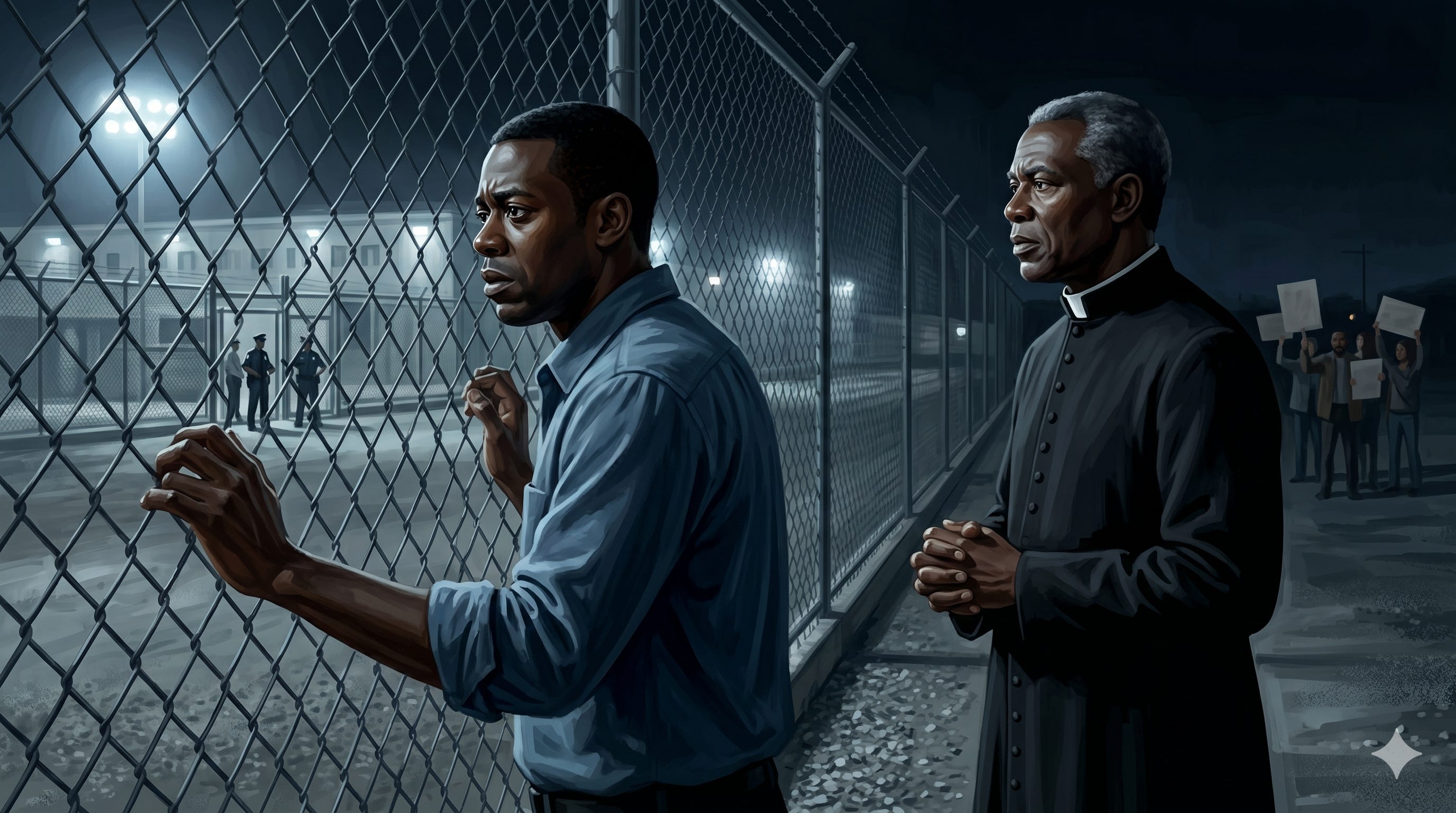
His name is Father Okeke. You find him on a Wednesday evening at the perimeter fence of the base, standing alone, looking in at the building with the attention of a man reading something. Not protesting. Not speaking to anyone. Just standing in his cassock with his hands clasped behind his back, studying the building.
He is sixty or so, silver at the temples. He wears his cassock without any self-consciousness. A man dressed for the work he does. He grew up in Awka, he’ll tell you later. Left Nigeria for seminary in Rome at twenty-two, ended up in California through a series of parish assignments that he describes without drama. You go where the Church sends you, he says later. He says it without complaint. He speaks like a man who started English as a second language and has now been using it so long that both languages have settled into something that is neither. You recognise the particular way of holding words that comes from growing up in one country and doing your thinking in another. It is the way you hold words, too.
“They won’t let you past the gate,” you say.
“Four months.” He states it as if he were stating the weather. “I’ve requested a meeting with Dr. Elias seven times. He hasn’t been available.”
Forty metres behind you, on the other side of the perimeter road, there is a group tonight. Larger than last week—thirty-five, maybe forty people. Church groups from the look of them, and some students with printed placards, and a man who has been here every single evening for three weeks carrying a sign that says only LAZARUS WALKED OUT HIMSELF in black block letters. Security watches them from a distance. Nobody moves toward anyone.
Father Okeke does not look at the group. He keeps his eyes on the building.
“What would you say to him?” you ask. “If they let you in.”
He considers this without hurry.
“I would ask him one question,” he says. “What they found inside the vessel when it opened. Whether there was something already there, waiting to be inhabited. Or whether the vessel was empty and the filling is the whole story.” He pauses. “Whether they called her, or whether they constructed her. Because those are not the same thing. Even if the result looks identical from the outside.”
You say nothing.
“You know the Lazarus account,” he says. It’s not a question. “What people forget—what I think people choose to forget—is that Jesus did not rebuild Lazarus from his components. He didn’t reconstruct the neurological pattern. He called. He stood outside the tomb and he called the man’s name, and the man came.” He pauses. “I have spent a long time with that story. The part that stays with me is that he called, and something answered. Something that was already there to answer.”
The fence is cold under your hand. You didn’t know you had put your hand on it.
“What if it worked?” you say. “What if she’s genuinely there? What if whatever came back is real— is her?”
He turns and looks at you for the first time. Not with comfort. Not with judgment. Something more rigorous than either. The look of a man who has learned to hold open questions without flinching.
“Then you will know,” he says. “The one it is will be known in the end.” He says it quietly, in the particular cadence that you last heard from your grandmother in Onitsha, and the sound of it in this parking lot in California, spoken by a man from Awka in a Roman collar, reaches something in you that nothing in the chapel managed to.
He leaves before you say anything else.
***
The call from Dr. Elias comes three days later.
He frames it as a welfare check. How is she adjusting? Her mood, her sleep? Her memory? Have you noticed anything unexpected in how she engages with familiar environments? He uses the word calibration twice. He uses the phrase within projected parameters once. A phrase not used about people. He uses it about Shelly.
“She’s well,” you say.
“Excellent. We’d like to schedule a follow-up assessment. At the facility. Quite routine.”
“I’ll ask her,” you say.
You put the phone down. You sit with what you now understand. Something you should have understood from the beginning and perhaps did understand but declined to examine. They built her, and she is still theirs. The follow-up assessment is not about her well-being. It is about their data. They need to know what held up and what failed, what the mapping captured and what it missed. Whether you are holding a proof of concept or a cautionary tale to be quietly filed.
You do not tell her about the call.
What you tell her, that evening, is that you want to take her somewhere.
8 | Where the Sea Gave Her Back
The dinghy takes forty minutes to clear the harbour. The engine takes a long time to find its rhythm in the cold. You navigate south, then southwest, following coordinates you have never written down because you memorised them from the accident report you read eleven times in the month she was missing. You don’t go to the actual location—forty nautical miles out is not a trip for a harbour dinghy. You go far enough that the city is gone, and there is nothing around you but water and the grey of an early Pacific morning. This water. This specific body of it. The storm that came through here nine months ago left no mark on the surface. The water is flat and cold. It has no record of what it has done.
Shelly sits at the bow. She has been watching the horizon since you cleared the breakwater, and you have not pushed her. This is not a conversation. You are not certain yet what it is.
You cut the engine.
The boat settles. The silence of open water fills the space around you. Not human quiet. Just the knock of the hull on small waves, and the distant cry of something far overhead.
She turns.
“You needed to come here,” she says.
“Yes.”
She looks at the water. You look at her as she looks at it.
“I was afraid,” she says. “In the water. I want you to know that. I don’t know if it matters to you, whether knowing that changes anything now.” She stops. “She was afraid.” You hear the shift in pronoun. She does not correct it. “The last clear thing I have is the thought of your name. I want you to know that.”
You don’t ask. You know what you want to ask. Is that her fear, or a reconstruction of what her fear would have been, given everything the mapping knew about her? You swallow it back.
“I thought about the eggs,” you say.
She makes the sound of someone fighting a laugh that caught them off guard. There is a catch in her throat, a pause before the laugh decides to come. You know that sound. You did not write it in the notebook because it did not occur to you that you had it memorised. You had it memorised.
“The eggs,” she says.
“The eggs,” you say.
She laughs. Properly, fully. It comes out before she can decide about it. She puts her forehead against your shoulder and laughs, and the boat moves under you both, and the Pacific is cold around you, and the sky is starting to go pale gold at the edge where the sun is making up its mind.
This is where she drowned. You are here, at the edge of where she drowned, and she is laughing against your shoulder, and you are holding her, and the question of whether she is Shelly or something that has inherited Shelly completely will not, in the time you have left on this earth, be answerable. You know that now. You knew it, probably, before you got in the boat. Maybe before you got in the van. Maybe before you walked out of the chapel and went to find Dr. Elias.
You hold her anyway.
The holding is its own answer. Not to the question of what she is. To the question of what you are—what you are willing to do, what you are willing to carry, what you choose when certainty is not available.
The Lazarus account says he walked out of the tomb still wearing his grave clothes. Nobody in the story explains what happened next. Whether the family sat down to dinner that night and talked about ordinary things, or whether they all sat there unable to speak, or whether Lazarus himself felt like a stranger in his own body for weeks afterward, trying to find his way back into a life he’d been pulled out of. The text doesn’t say. You have been reading it, looking for the theology. The grave clothes are still on him when he comes out.
The sun comes up. You stay on the water until it has fully arrived.
9 | What the Lanterns Carry
The lanterns are her idea.
She buys them at the farmers’ market on a Saturday morning—eight of them, paper, red and gold—and she brings them home and sets them on the kitchen table and says, “On Sunday. The water. She says nothing else. She doesn’t need to.”
You go back to the bay on Sunday evening. The quiet one near the edge of the neighbourhood, where the water is dark and still, and the opposite shore is close enough to see the lights on. Evening comes in slowly. You stand there and let it.
She lights the first one. You light the second.
You don’t make speeches. You don’t name what the lanterns are carrying, or who they are for, or what you are releasing. Each one goes out over the dark water, and you watch it until the flame is too small to distinguish from the stars beginning to appear, and then you light the next one.
Your grandmother set out food on the anniversaries of the dead. She believed they returned. She kept their names in daily speech, set their plates at the table, and let them occupy room in the present, the way living people do. The Church taught you they rose on the last day, bodies made whole, recognisable, glorified. Dr. Elias believes the mind can be reconstructed from what it has mapped, that a person’s architecture is data, and that data can be recovered. Shelly believed, in the kitchen with an egg in her hand, that the weeping mattered as much as the raising. That the dying was not cancelled by the coming back.

None of these answers sits still inside you. You have turned each one over in the nine months since the Coast Guard called and in the weeks since the vessel opened. You do not know how to make them resolve. Your grandmother told you the spirit is not a tenant. That it doesn’t take one house and stay. You used to think she was talking about the afterlife. Standing at this water, you think she was talking about something much larger than that.
The last lantern goes out.
Shelly takes your hand. Her hand. The weight of it, which is the weight you know. Or the weight you remember. The two have become indistinguishable, and you have stopped fighting them.
You don’t look at her. You look at the place on the water where the last lantern was, and then at the place beyond that, where the water meets the dark.
The one it is will be known in the end.
You have been waiting for the knowing since the chapel floor. Since the van. Since the morning two hundred and seventy-six days ago, when you stood in the kitchen doing arithmetic that has never been resolved.
You are still waiting.
You hold her hand.
You let the water carry what the water will carry.