

1 | When Granite Walked
They arrived at the hour the sun turned everything it touched to brass.
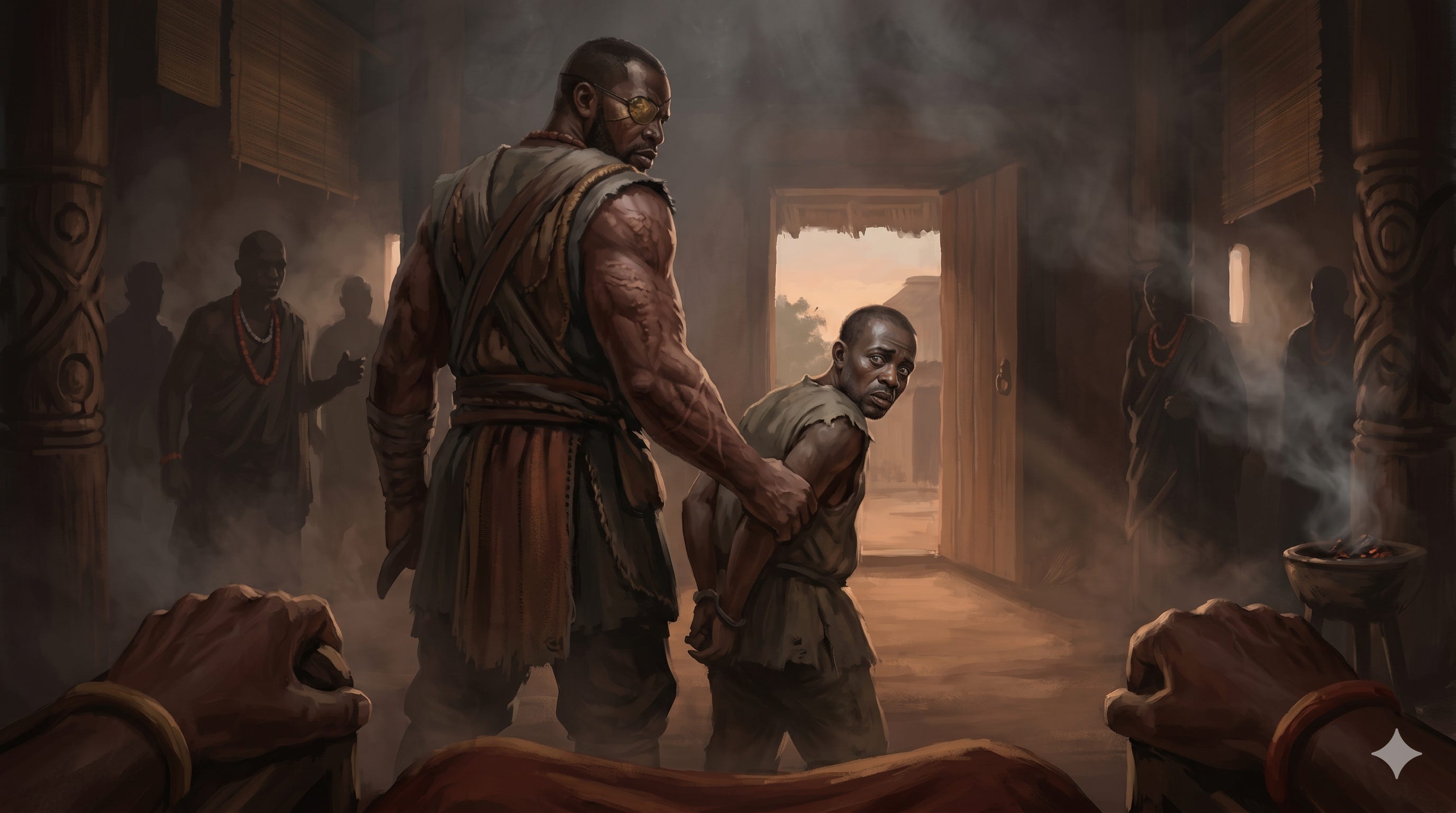
Achala’s footsteps came first. Deep, unhurried, each one louder than the royal drum. Then the prisoner appeared, strung between two guards on a carrying pole threaded through his bound wrists. He was short and barrel-bodied, his toes dragging twin furrows in the dust. Each time he bucked, the guards tightened their grip and said nothing.
We had been settling the yam levy disputes. The air was thick with cedar and myrrh from the incense dish I kept burning during Ndi Ichie meetings. It slowed their quarrels. The cicadas outside kept working. When Achala came through the door, the room stilled.
My border chief stood a full head above any man in the hall. The scar tissue on his arms had the texture of bark: thick, ridged, built up across years of things I hadn’t seen and hadn’t asked about. One eye moved; the other hid behind a battered gold patch he’d worn since before I knew him. When he halted, he dropped the prisoner at my feet with the tenderness reserved for sacks of millet.
“Forgive the intrusion, Eze Ebubedike,” he rumbled. “We found him beyond the great iroko that marks Ichere soil. He will speak to no one but you.”
The prisoner raised his head.
His eyes were large and very still, the colour of ash from a fire that has burned for days and gone cold. Pain had taken up most of the space in them. What remained was the decision to keep moving.
“My king.” He coughed, cleared blood from his throat, and spat it onto the swept clay floor. Then, steadily: “I am Nwokeka. I serve the Eze of Ichere. I am not a spy. There is a thing happening at our border, and if it reached mine today, it will reach yours before the next dry season.”
Behind me, Ichie Akata moved. His amber beads clattered against his broad chest before his feet reached the centre of the room. He came level with the prisoner and stood over him, already decided what this man was worth.
“Nwokeka of Ichere.” He said the name like a verdict. “The last men Ichere sent across our border sent twelve of our traders home in pieces. I can name them if you’d like. I remember every one.” He turned to me. “Whatever this man is carrying, Eze, it was packed by hands that are not clean.”
I studied Nwokeka. He didn’t flinch from Akata. He looked at me.
I silenced Akata with a gesture: palm flat, two fingers down, the signal we’d used since before the council learned to argue. The unease in my chest was not new. I had felt this before. Something arriving before I was ready to name it.
For five harvests, we had held the border. No skirmish, no stolen cattle, no crossed spears. I gave the credit to Achala’s men at the iroko tree and to the fact that testing them had never seemed worth it to anyone with sense. We called it peace. It was the daily decision not to start a war, made on both sides by men who were tired of paying for the last one.
Now this.
“Take him to the Sun Court,” I said to Achala. “Water and food. Leave his hands free. He is a guest until I say otherwise.”
Akata hissed through his teeth. Achala’s nod was barely a movement. As they left, Nwokeka looked back at me, and I saw in his face a prayer that had run out of words.
2 | Words Carried on Broken Wings
I called the council back the following morning.
Nwokeka had slept. He had eaten. He sat on the woven mat I had placed for him in the centre of the hall. When he spoke, his voice was steady. He had done all his falling apart in private.
“You welcomed the white-skinned men,” he said, his gaze on me. “Ichere welcomed them. We offered kola. We showed them the river crossings. We thought they were merchants. Their cargo was wrapped and their manner was patient, and we were wrong.”
He stopped. He drew a breath.
“They burned the shrine of Ogwugwuno three months ago. High priests had maintained that shrine since before my father’s father was named. They put a bullet through the throat of the one who held the morning libation, while the pot was still in his hand.” He did not look away from me. “Our spears do not touch them. Their guns reach us before we can close the distance. They breathe fire through iron. My Eze begs alliance. From weakness, yes. But from the truth above all: alone, we cannot survive. What has come to Ichere is moving. It is already moving toward you.”
The men broke into noise. Fear in some voices, calculation in others, and underneath everything, the sound of men whose positions were at stake.
Akata waited until it quieted. Then he rose.
“The Eze of Ichere,” he said, placing each word deliberately, “is a man who sent killers across our eastern border eighteen months ago. Twelve of our traders. Obi Ezenwata. His son Chukwuma. Two brothers from the Okafor household. Men with yam farms growing weeds now because they have not come home.” He paused. “I do not ask this hall to forget what their king did. I ask only whether the blood on his hands has dried enough for us to hold them.”
Nwokeka did not raise his voice. “The men who took your traders were Ochichi raiders. Stateless men. My Eze condemned the attack. He sent restitution.”
“He sent words,” Akata said.
“He has nothing left but words. They have taken the rest.”
The hall went quiet.
I looked at Nwokeka. I looked at Akata. I looked at Achala standing against the far wall with his arms folded, his single eye moving from face to face. Whatever I decided, he would execute. The weight of the decision was mine alone.
“Two days,” I said. “I give this matter two days. We reconvene at the second dawn.”
Akata bowed. His eyes were still, and they said what his mouth wouldn’t.
Nwokeka pressed his forehead to the mat. When he raised it, I saw he had hoped for more and was already deciding whether what little he’d gotten was worth riding home on.
I left the hall. I told myself that the two days were for careful thinking.
3 | Night with a Stuttering Lamp
That night, I walked the ramparts.
The torches on the western wall burned in a line toward the horizon. Beyond the iroko tree, which I could not see from here but knew by instinct, the dark was complete. The southern sky held a grey smear along its lower edge that had been there for three nights running. I had been telling myself it was farmland burning. I didn’t fully believe this.
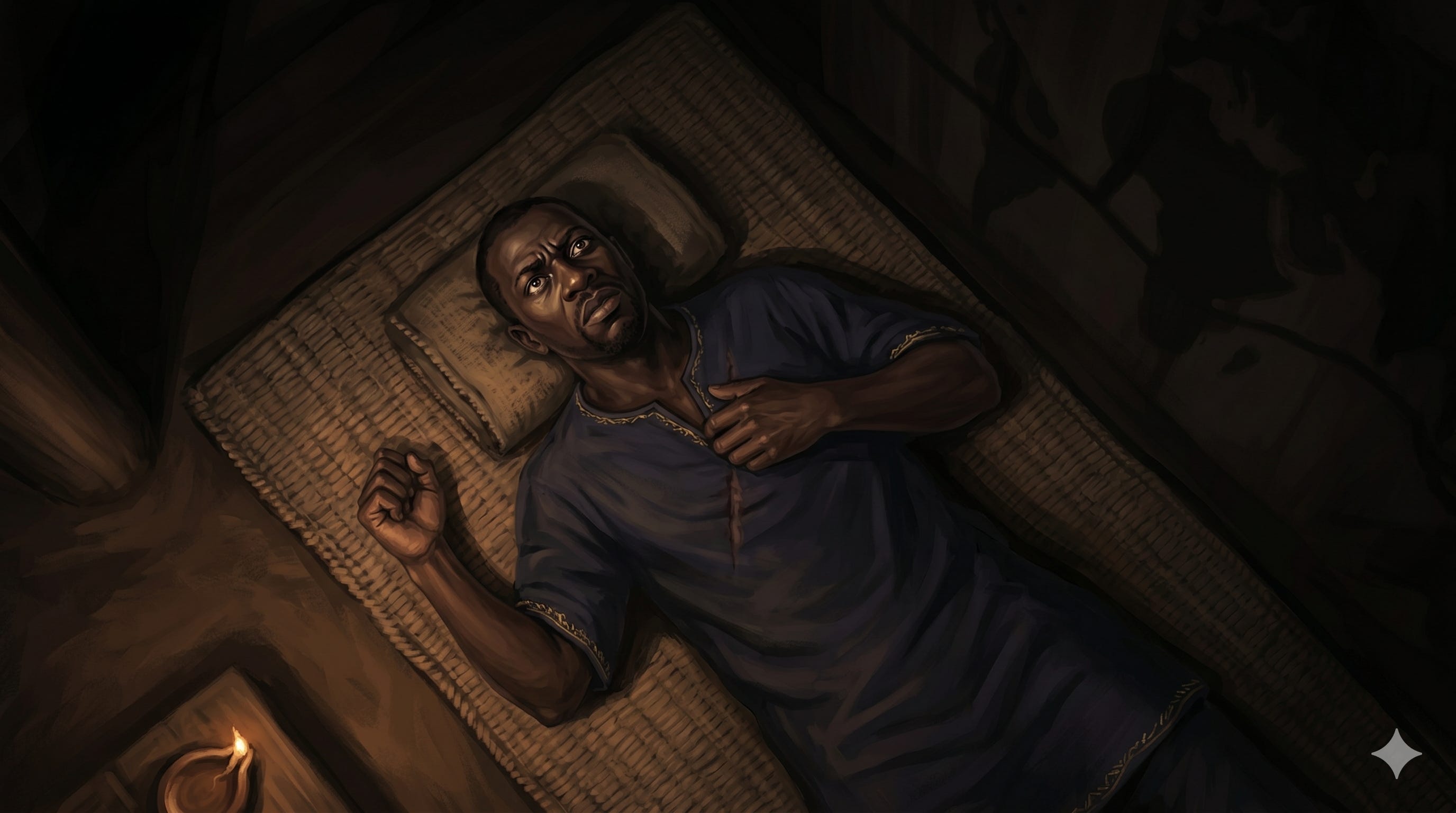
I went to bed. The dream found me almost immediately: a straight road cut through thick bush where there had been only footpaths, pale men walking its length with instruments I couldn’t name, my people kneeling in the red dirt beside it. I woke with my hands knotted in the sleeping cloth. The cedar in the bedchamber incense had burned flat.
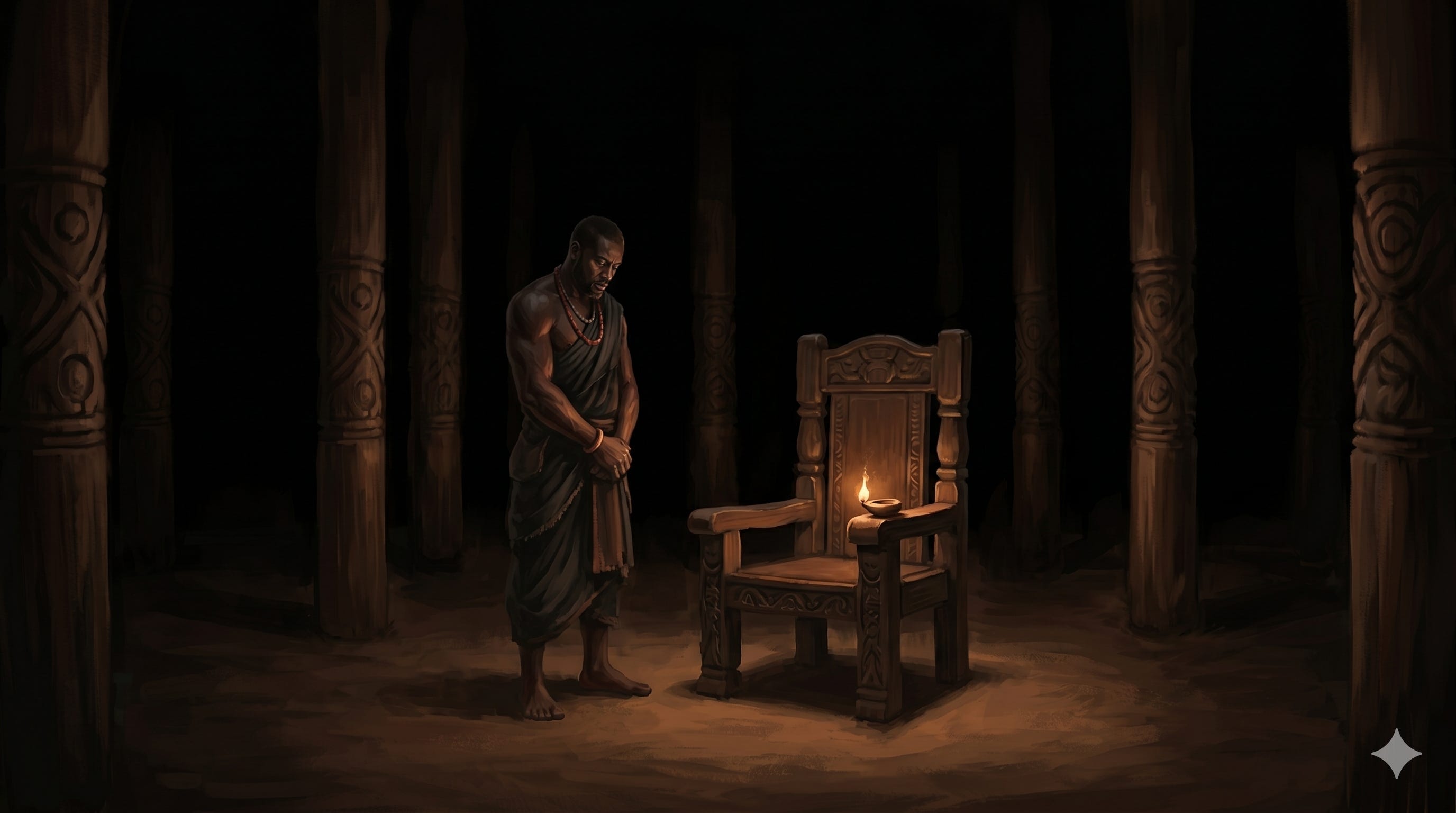
I dressed and went to the throne room. The torches were low. The throne was empty and small in the dark.
The memory of my father’s burial came without an invitation.
The kingdom three days into grief. His body not yet cold. The chiefs were already rearranging themselves around the absence he’d left. I was seventeen and wearing the student’s bead belt and standing beside the bier, and Akata had appeared at my elbow, already there as he always was, as though I were the one who had only just arrived.
“You understand what happens now,” he said.
“I will lead,” I said. Seventeen years old. It was the only answer I had.
He studied me with an expression I had no name for then and could not escape now. “Your father led through iron. You will need your own way.” He paused. “I will support you. I am saying this now, before the council has settled anything. My support is yours. Remember that I am saying it now. And remember that nothing comes without a price.”
He walked away before I could respond. I spent three years understanding the price. By the time I did, I had already paid most of it.
***
The queen found me near the second hour of the night.
She came through the side passage with the small clay lamp she used when she didn’t want to wake the servants. Her feet were bare. She set the lamp on the armrest of the throne as though the throne were any piece of furniture, and she looked at me.
“You need to know something,” she said.
She moved directly to what she had come to say. That directness had been one of the things I loved about her since the beginning.
“I went to the Sun Court this afternoon,” she said. “While you were in council. I spoke with Nwokeka.”
I hadn’t known this. “And?”
“I asked him what I thought you hadn’t asked. Where exactly had the strangers been seen, and how recently.” She crossed her arms against the cold. “Three of them, moving along the eastern pass, six days before he left Ichere. They carried brass instruments on wooden legs. The kind for measuring land and distance. He described them carefully because he didn’t know their names.” She paused. “They are mapping us, Ebubedike.”
She waited for me to count.
Six days since those men were at the eastern pass. Three days on the road. Two days in our Sun Court. Eleven days since anyone had confirmed where they were.
The lamp between us burned without wavering.
“I will decide in the morning,” I said.
She looked at me. She had already decided. The gap between her answer and mine was its own kind of silence.
“The morning,” she said without inflexion. She picked up the lamp from the armrest and went back through the side passage.
I stood in the dark throne room for a long time.
I told myself it would be clearer at first light.
4 | Council of Splintered Spears
The second morning was grey and windless.
Nwokeka had not slept. It showed the moment Achala brought him in. Eyes pulled back, lids heavy, jaw set around nothing. Whatever was keeping him upright had nothing to do with rest. He sat where I directed him. His hands were steady on his knees. That steadiness was the hardest thing in the room.
I watched where each chief positioned himself as the council filed in. Okafor of the western quarter stood near Akata; he had been there before most of the council assembled, which told me where he had spent his night. Emeka the Elder sat apart with his arms folded, reading the room before he committed. The younger chiefs near the door had not decided and wore it openly on their faces.
I asked Nwokeka to speak first.
He told them what he had told me, and then one thing more. The Eze of Ichere had sent three messengers before him. He was the fourth, and the only one who had arrived.
“I am the fourth,” he said. Just the number, and it happened to be true. “I did not come because I am brave. I came because I did not stop.”
Nobody spoke.
Akata took the floor. He spoke for a long time. The traders were real. The grief of their families was real. The political risk was real: an alliance built on a freshly broken wound, two armies, two command structures, and two sets of unresolved grievances fighting side by side. I had turned all of it over in my own mind in the dark. I knew the shape of his argument before he finished making it. He sat, and I waited until the sound of his voice had cleared the room.
Then I rose.
“My grandfather made treaty with the Adani clan,” I said. “When he did it, the blood between our peoples was barely dry. His Ndi Ichie told him what yours are telling me: that an enemy’s hand does not change by opening. He said: Egbe bere, ugo bere; nke si ibe ya ebena, nku kwaa ya. Let the kite perch and let the eagle perch; whichever refuses the other, may its wing break.” I set my hands flat on my thighs. “We held that treaty for forty years.”
No one spoke.
“One more day,” I said. “I need one more day. The weight of what we answer here must be carried by all of us, and I will not carry it alone before all of us are ready.”
I looked at Akata as I said this. He looked back at me. What I saw in his face was patience. He had read me correctly. He could wait me out.
Nwokeka pressed his forehead to the mat, held it there a beat longer than courtesy required, and when he rose, his face had gone still.
I left the hall without stopping to speak to anyone. I did not want to be caught in their reading of what I had just done.
5 | What the Two Days Showed Me
I rode through the city that afternoon in plain garb.
The market ran in both directions from the central palm: cloth merchants east, food sellers west, the blacksmiths’ quarter behind them, where the hammers ran from first light until dark. I had ridden this road since I was old enough to sit on a horse. I knew which vendors kept honest weight and which didn’t, knew the family quarrels that drove every pricing dispute. I had told myself that knowing my city was the same as protecting it.
I rode past the salt sellers. Between two women arguing over dried fish, I heard the word Oyibo—white man—dropped into the middle of a sentence and covered over quickly. I kept riding.
Near the blacksmiths’ quarter, I stopped.
Seven or eight children played in the red dust of the road. One of them, Emeka, the blacksmith’s son, a boy I had given a carved wooden lizard to at the last yam festival, held a long stick angled up against his shoulder. He was barking syllables in a made-up language, loud and nasal, chin raised. Ahead of him, five other children walked in a line with their wrists pressed together in front of their bodies. When he barked, they stopped. When he barked again, they started. They knew the positions. They had practised.
A woman sat outside the blacksmith’s doorway, sorting iron filings. I kept my voice low.
“How do they know that game?”
She looked up, assessed me in my plain garb, and made her calculation about who I was. “Ikenna’s uncle. He came back from the eastern road last month. He saw the strangers march a chain of people down to the river crossing. Tied together. He described everything—how they walked, how they stopped, what held them. He told his brother. His brother told the children.” She set a piece of iron aside. “Children make games out of everything.”
I sat on my horse and watched them until I could not anymore. Then I rode on.
At the barracks, Achala finished a drill sequence before he came to me. When he did, he wiped the sweat from his knuckles. “Two scouts came back from the eastern pass this morning,” he said. “Boot prints unlike anything we’ve seen in the seven lands. Thick-soled, mechanically even, every print identical to the last. Twenty pairs at a minimum. Moving south.”
“How far from the iroko tree?” I asked.
“Three days’ walk at the pace they were moving. Possibly less now.”
“You learnt this when?”
“This morning. Before council.” He met my eyes. “I sent word through Okafor’s man. I expected it to reach you.”
Okafor. Who had spent his night standing beside Akata.
I rode to the Sun Court at the last light.
Nwokeka was sitting with his back against the wall, knees drawn up, hands loose in his lap. He was still working something out.
We talked for a long time. He told me about the Eze of Ichere. The man, not the title. A man who had buried two sons in a single season to foreign guns. Who rose before dawn to pray before the idols they hadn’t yet taken. Who had sent his last grain surplus to the displaced villages before they reached the shrine, because he understood that hunger would arrive before any other enemy.
“He stretched his hand across a history that was bitter on both sides,” Nwokeka said. “Because there was nothing else left to reach with.”
“If I say yes,” I said, “when do you need to leave?”
“Tonight. Tomorrow at the latest.”
I was quiet. Then: “Sleep here tonight. I will have an answer at first light.”
He looked at me. I knew that look. He had heard this before. From this kind of man. In this kind of room.
“Eze,” he said. He stood short and very still. “I cannot prove the Ochichi were not my king’s men. I know it, but I cannot prove it to your Ndi Ichie. I know Akata will not believe me, regardless of what I say. I know there are men on your council who will vote no before I finish speaking.” He paused. “I am asking you, not your council. You. What do you believe?”
I knew what I believed.
I had known it when the queen stood in the dark throne room and told me they were mapping us. I had known it that afternoon, watching the children in the road.
“First light,” I said. “I will have an answer at first light.”
He rose without a word.
I rode back to the palace. I lay on my mat. One night, I told myself. Just one night, and then I will do the thing I already know must be done.
I believed this.
6 | Before the Rooster Could Speak
What woke me was the silence.
The guard on the eastern wall called a short, low note every hour throughout the night. I had heard it for five years without noticing it. That was how night worked. That morning, the hour came, and the call did not. I lay still and listened to where the sound should have been, and then the screaming started, and I was already moving.
Something heavier than cedar came under the door before I opened it, with a burnt sweetness underneath it that sat wrong in the throat. I pulled my sword from the wall and went out into the corridor, and the corridor was orange.
The armoury thatch was burning. Arrows made of fire crossed the open courtyard in long arcs, touching down, taking hold. Men in coarse brown coats moved through the haze in a loose line, and the long sticks in their hands made a sound I had never heard in five years of careful border-keeping. Each time the sound came, a man went down and stayed down.
I bellowed for Achala.
He came from the eastern corridor without his helmet, a cut on his cheek so fresh it was still welling. His axe carried someone else’s blood. “Tunnels,” he said. No preamble. “Under the eastern grain stores. We thought they collapsed during the flood season. They knew otherwise.”
We moved forward together. My sword found two of them, glancing strikes, enough to slow them, and their companions pulled them back without breaking the line. Two men I had known since boyhood went down in the dust ahead of me. Obi of the palace guard. Chidera, who had taught me to throw a spear when I was nine years old. They fell like yams pulled too early. The body not yet understanding what has happened to it, the knees going before the mind does.
I saw my queen’s hut across the courtyard. Its reed roof was still intact.
I ran.
Two of them stepped into my path. I dropped below the first swing, drove my shoulder into the man’s chest, and we went down together into the dirt. The second came from behind. I rolled clear. A rifle butt struck my shoulder, and I stumbled but kept my feet.
The queen appeared in the doorway of the hut.
She had the large iron cooking pot in both hands, the one she boiled the morning corn in, and she had pressed herself against the left side of the door frame, out of the direct line of entry. She had thought about the angle. She had heard them coming, and she had already decided where to stand and what she would do.
The first man through the door took the full pot in the face. The water was still steaming. His scream cut through everything else. The second man fired before the echo finished.
I heard the shot.
I saw her fall.
She fell through the doorway into the morning light, arms open and loose, already gone before she reached the ground.
The sound that came out of me has no name in any language I know.
I went at them. Skill had left me. Something older had taken its place. A rifle butt found my ribs. I was still moving. Another blow. Still moving. A third put me to one knee, and Achala’s axe came over my head and took the man who had landed it.
Achala was roaring something. It reached me muffled, somewhere far away.
Through the smoke. Across the courtyard. Akata. He had twin blades, the short, curved kind, the ones the Ichie who had soldiered before politics sometimes kept. He had come prepared. I had not. That told me something I was too late to use. He moved toward a cluster of the brown-coated men, and his blades were fast, and his face had a fury that had no room left for fear or calculation. He was going to die, and he had decided it would mean something.
A gun fired.
He stopped.
He looked down at his chest. His knees went. The battle did not pause.
A horse crashed through the smoke from the northern gate. Nwokeka. Blood at his temple, one arm hanging wrong. He was shouting my name or the Ichere word for warning; in Ichere, the two sound alike. He never finished it.
The shot lifted him backwards off the horse. He came down in the dust at my feet. Close enough to catch. It was over before my body understood what it was seeing. He lay on his back in the dirt of my courtyard with his eyes open and fixed, and the last thing he had said was my name.
“Stay alive,” Achala said, pulling me behind a fallen pillar.
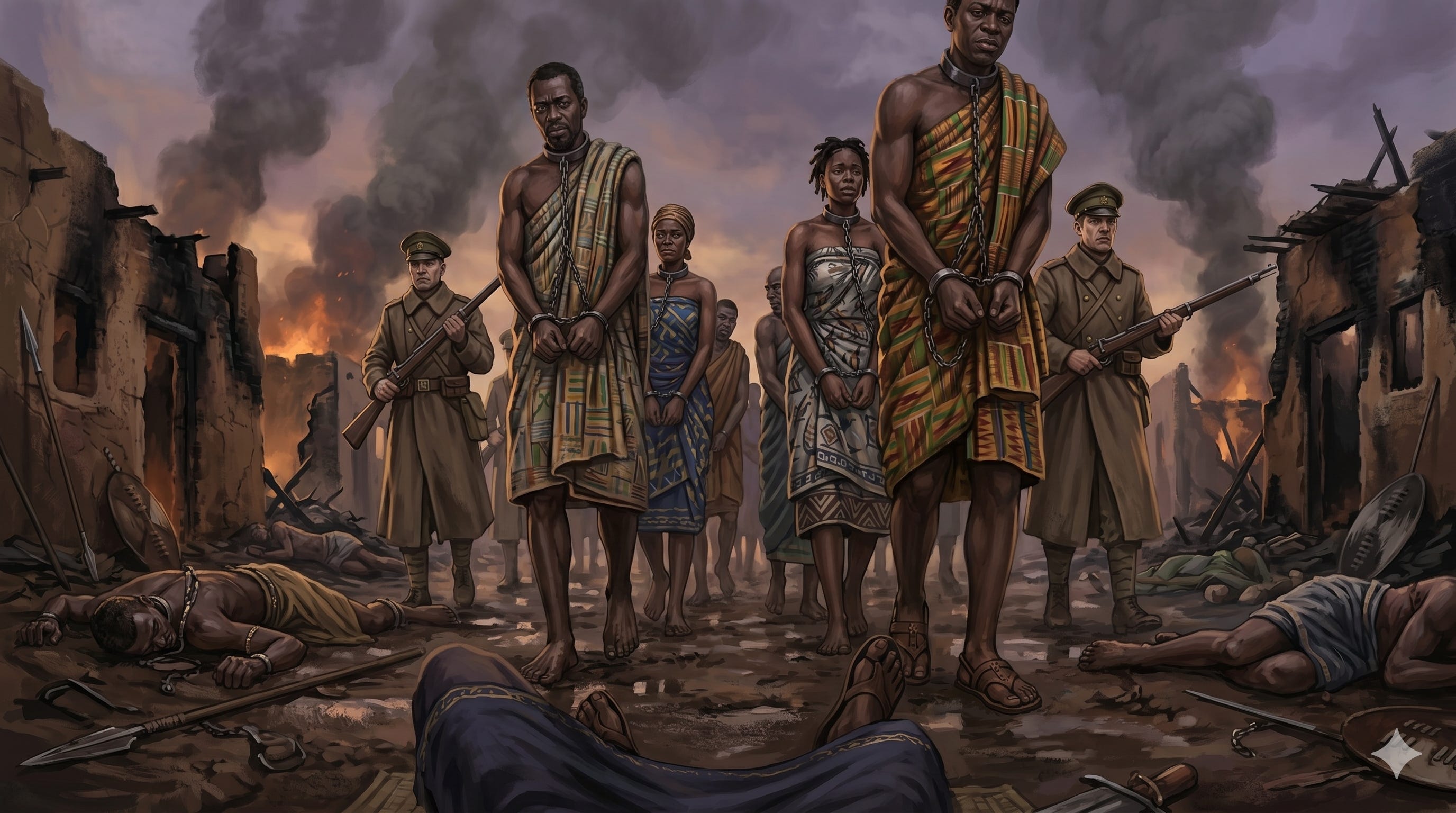
There was nowhere to retreat. The bronze gates were molten at the hinges. My people were being driven toward the northern road in groups, heads down, the brown-coated men moving alongside them with weapons raised. The ground was shrinking to a smaller and smaller ring of men still standing.
A rifle butt struck me hard between the shoulder blades, all the weight of a body behind it. The courtyard tilted. The ground came up. The packed clay hit my face.
7 | Ash Writes the Final Treaty
I was lying on my side.
My cheek against the packed clay of the courtyard. From this angle, I could see the base of the far wall, the toppled drum, and the feet of people passing, some in boots, some in sandals, some bare. Nobody stopped. Above me, the strangers called orders to each other in their flat, clipped language. Somewhere I couldn’t see, someone was moaning. Iron was being fitted to things.
Nwokeka was three feet away.
He was small. I hadn’t registered how small he was while he was moving through the world. Now I could see it plainly: the compact frame, the hands of a small man, the worn calluses on the inner edges of his feet from however many days of walking before Achala’s men found him past the iroko tree. He had been the fourth messenger. He had not stopped when the others stopped. He had carried the warning across our mutual history and our suspicion and over our border, and we had let it go to ground in our arguments until nothing remained of it.
A soldier came from my right. Young. They were so young, most of them. His face was marked with soot that didn’t hide the expression underneath it. He levelled his gun at my chest. I looked at the barrel. Something cold settled in me. Just a length of metal. That was what they had come with. A length of metal and the certainty that it settled questions faster than councils did.
Two soldiers conferred above me. One pointed toward my chest. The other shook his head and gestured north toward where the captives were being driven. I couldn’t follow their words. I followed the gesture. They were deciding whether the cost of a bullet was worth what lay at their feet. Whether a wounded king had value as cargo.
The one who had shaken his head won the argument.
The rifle butt swung.
The sound was like a door slamming shut inside my head.
Then nothing.
8 | Silence with Teeth
Sound returned before sight.
Somewhere nearby, out of sight, a person was breathing through a hollow piece of wood. Just a breath. In and out, with no melody.
I was on my back. The sky above me was the yellow-grey of smoke beginning to thin. I could not move my legs. I became aware of this gradually.
I turned my head.
Women moved past in iron neck-loops, three abreast. Old men, bayonets at their backs, moving in small, pushed steps. A child, young enough that the iron loops meant nothing to her yet, rode on her mother’s hip with her face pressed into her mother’s neck. Her mother held her with both hands, one flat against the small back, the other cupping the child’s head.
I knew the mother. Ngozi. Her husband brought the first yams of each harvest season to the palace. I had seen her at the last festival laughing at something, her head thrown back.
I opened my mouth.
Nothing came out.
A gap in the smoke, and I saw Achala.
Stripped to the waist, wrists bound behind him with rope wound twice and knotted where he couldn’t reach it. Ten soldiers ringed him with weapons out. Whoever had done the binding knew rope alone would fail. He worked the rope continuously, steadily, without panic.
He raised his eyes and found mine across the distance.
He held the look for a moment. Then he dipped his chin. Once. Small. Deliberate. I did not know if it was a bow or a farewell. I think it was both. I think he gave me what he could see I needed, because that was what he had always done.
They struck him from behind. He dropped into the dust.
I wept.
The tears moved sideways across my face. I had been taught that a king’s grief lived only inside him. That a king’s outside stayed dry and unreadable. I had tried that. It had not saved one person. Nwokeka, dead at my feet. The queen, gone at the doorway. Akata somewhere in the smoke. Every man who fell in that courtyard.
The cold came up from the clay floor in slow stages. I could feel the places where the ground still held the heat of the day, and the places where it had already given it up.
My legs were gone. My hands were going.
9 | What Endures After Burning
I watched the clouds darken.
Gunfire still reached me, but less often now, and from far away. The drumming inside my chest had slowed until I could count the space between beats. The space was growing.
I thought of the queen.
I thought of her hands on the iron pot. I thought of her standing against the left side of the door frame, measuring the angle, while I lay in the dark, telling myself it would be clearer in the morning. She had already decided. She prepared.
I thought of Nwokeka. The fourth messenger. He had said it plainly. Just the number, and it happened to be true. I had not asked him about the three who came before him. I should have asked. You learn something about a man from understanding what he came through to reach you.
I thought of Akata in the last minutes. Both blades moving.
I thought of Achala. There were no words in me for Achala.
The captives moved north toward the river road. I could hear them moving. Many feet. The low clank of iron. Commands from the men alongside, sharp and occasional. A long column. I counted what I could see until the smoke hid the rest.
This was my kingdom’s last march. It had no drum.
I pressed my palm flat against the earth.
I said: Remember them. Even if nothing else does. Remember who they were before this morning.
The soil was warm from the day’s heat, soft from the season’s rains. It held my hand without answering. It did not need to.
The hollow-wood sound continued somewhere nearby. Still one person alive. Still breathing.
My heartbeat staggered. Once. Twice.
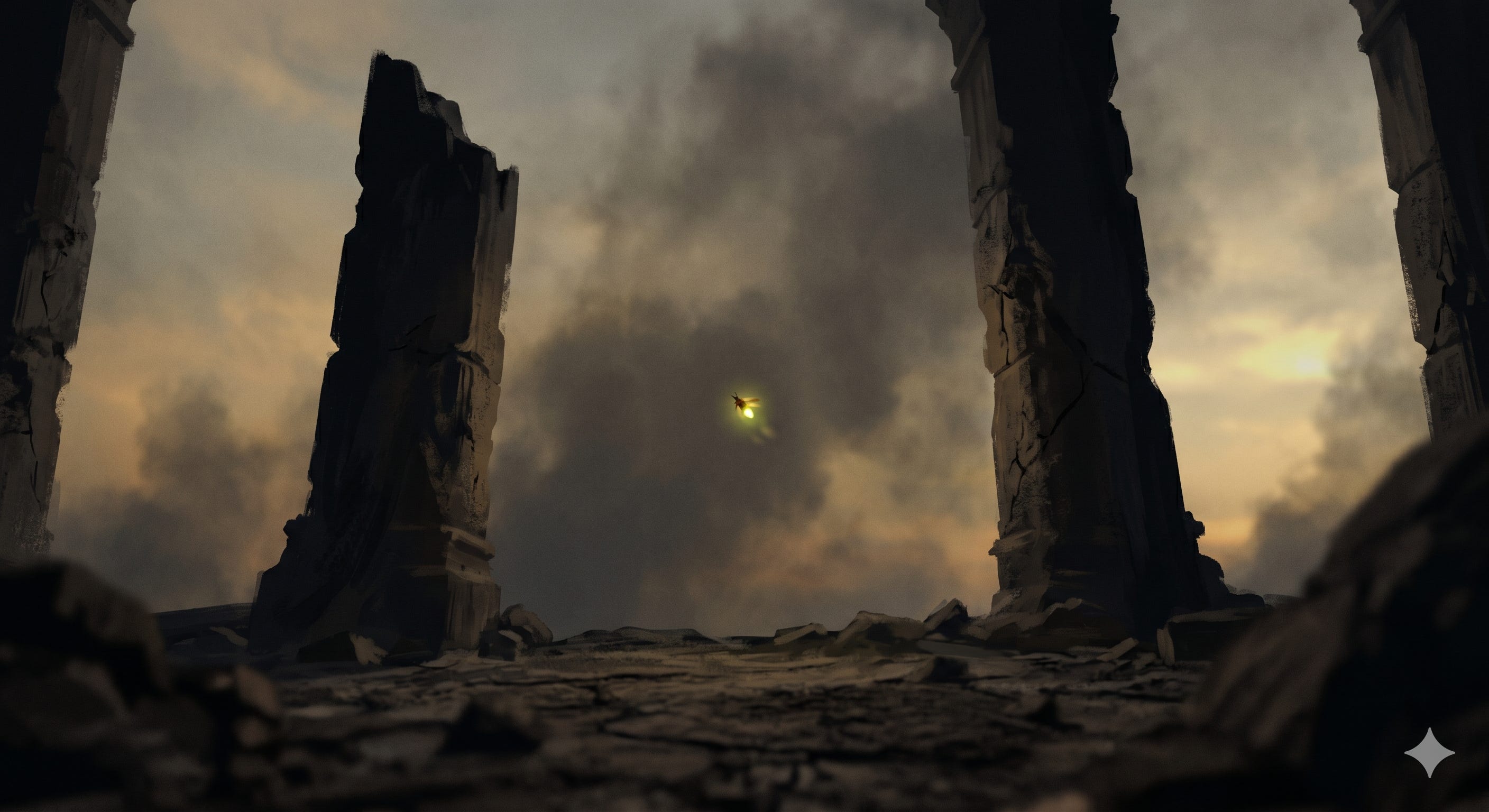
A single firefly crossed the gap between two broken pillars, high up where the smoke had not reached. Small. Unhurried. Entirely indifferent to what the ground was doing. It crossed the gap and was gone.
My heartbeat staggered once more.
Then it did not.
10 | Epilogue Written by Wind
Night came over the ruins.
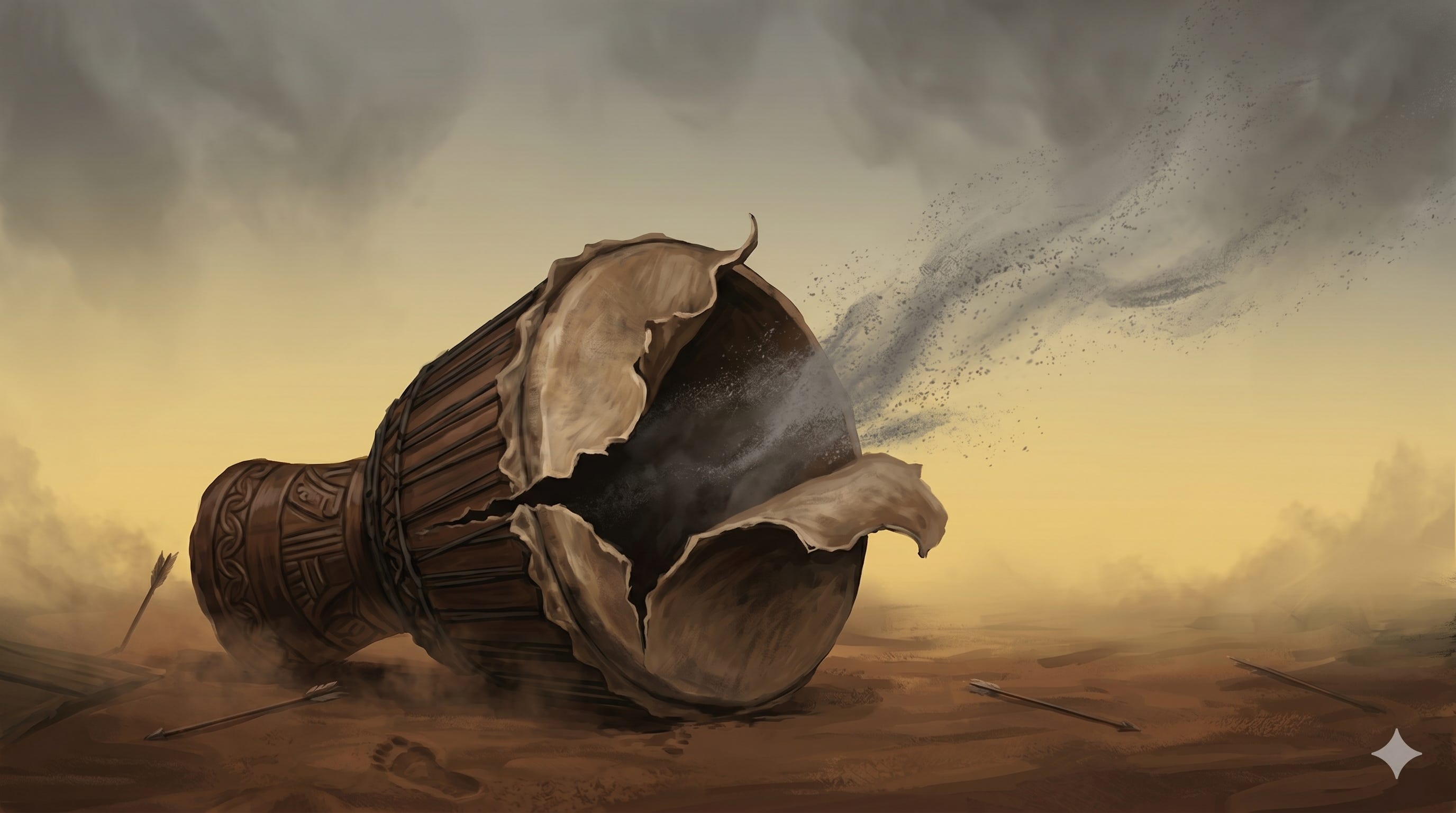
Fireflies drifted through the spaces where the gates had been, their lights small and indifferent to empire or rubble. The toppled drum lay split in the centre of the courtyard, its goat skin cracked along the length, edges peeling away from the wood in curls the width of a finger. Ash moved in the small winds that came after dark, settled, and rose again when the next wind came.
They renamed our rivers.
A season or two later, long enough for them to draw the maps and send them across the water to men who would never set foot on this soil. But they renamed them. The Oguta, which had fed the eastern yam fields since before the memory of the oldest keeper, became a word in another language. The Idemili, which the fishermen recognised by the sound it made each season, became a line in a document written in a script none of our people had been taught to read.
The iroko tree at the border still stands.
They did not cut it down. Perhaps they didn’t know what it marked. Perhaps they knew and decided it no longer mattered.
Some nights, the wind moves through the empty courtyard and stirs the ash into shapes that last a moment before they break apart.
No one sees it. No one has a name for it.
But the ash is still moving.